Our iSPACE team makes a point to keep our eyes on new developments in workplace technology solutions. Whether we’re visiting InfoComm for the newest releases, meeting with our manufacturer partners to demo new systems, or listening to the needs of our customers, it’s in our best interest to differentiate true trends from fads to ensure our collective success.
Our team recently found some time to compare notes about what we’re seeing in the industry. A few common threads seem apparent: bundled video conferencing solutions are more plentiful and are simplifying deployment processes; new, breakthrough LED video wall systems are setting new standards in both reliability and experience; AI is increasingly more integrated into solutions; smart furniture systems can make video deployment easier; and, little things matter – like how USB-C is being more widely adopted across systems.
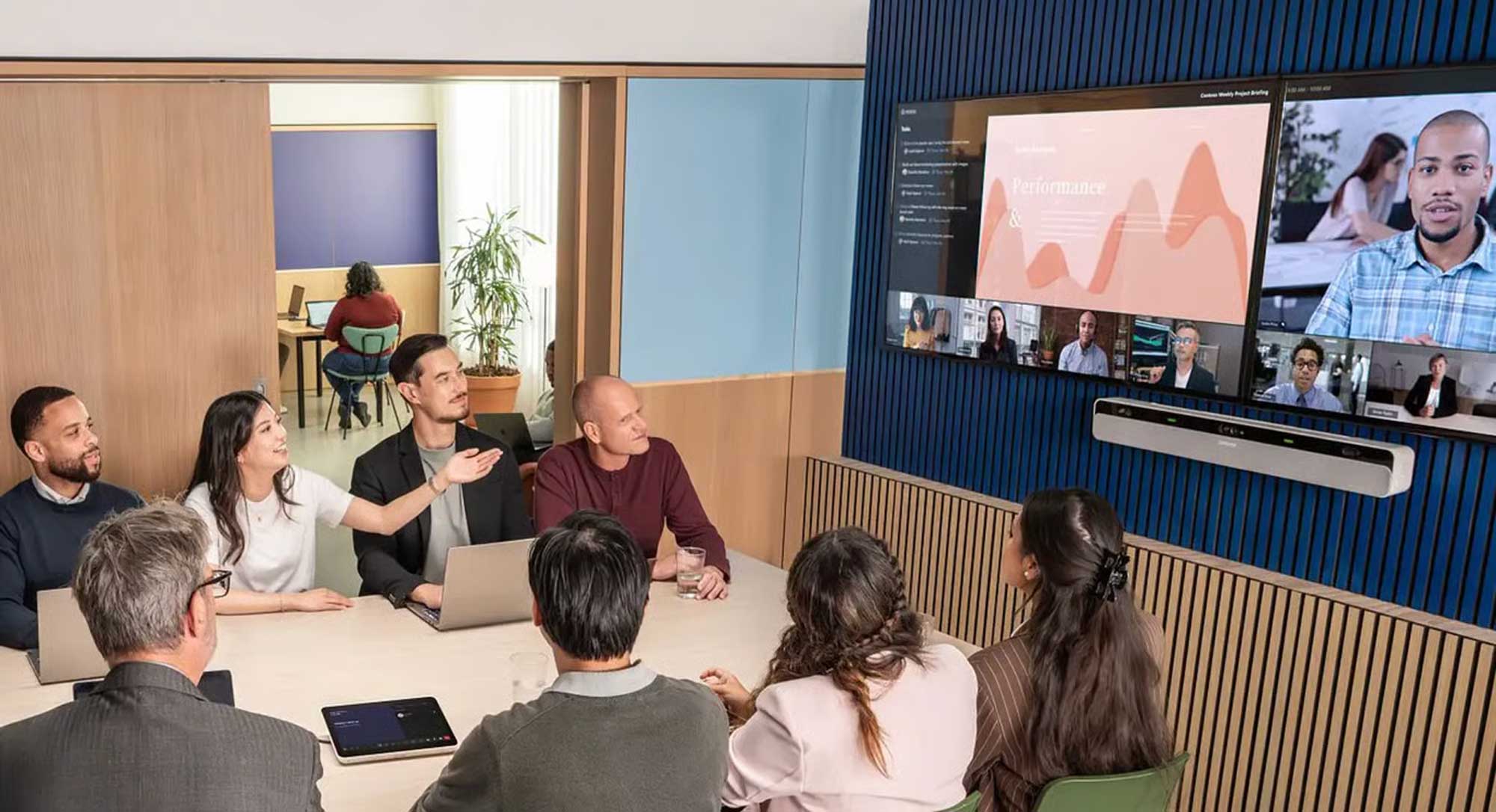
More manufacturers are offering complete room solutions that bundle hi-quality video, audio, meeting software, and system & collaboration controls. What’s the benefit? More efficient deployment. Microsoft TEAMS and Zoom Room Systems, for example, with expertly-tuned components from a single manufacturer, can often be more efficiently deployed and supported than systems assembled from different manufacturers.
One new, all-in-one video conferencing system worth a look is the SHURE IntelliMix Bar Pro. For medium to large collaboration spaces, the system combines SHURE’s advanced array microphones, four 4K cameras, and stereo speakers into a single bar, connected to a 10-inch touch panel.
SHURE’s IntelliMix View, AI-driven framing technology, drives both the audio and video, allowing the system to focus on active speakers across different room setups. The system is built on the Microsoft Device Ecosystem Platform (MDEP) which makes it TEAMS certified, and capable of remote management via ShureCloud.
LED video walls are rapidly becoming the standard for large-format video deployment. Innovations in pixel pitch have greatly enhanced image quality and created new viewing distance options; pixel-level redundancy technologies are making systems more reliable and improving overall image consistency; and flexible, modular designs support deployments in extraordinary environments.
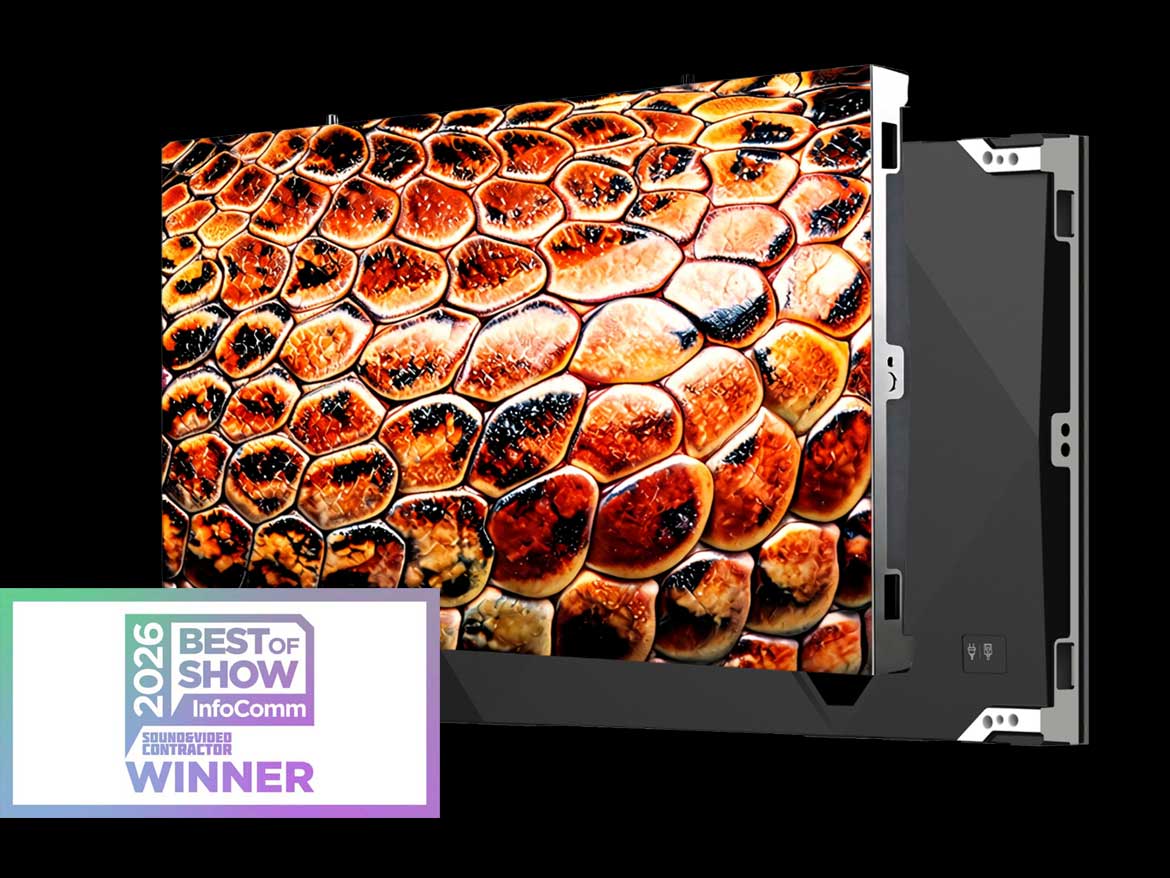
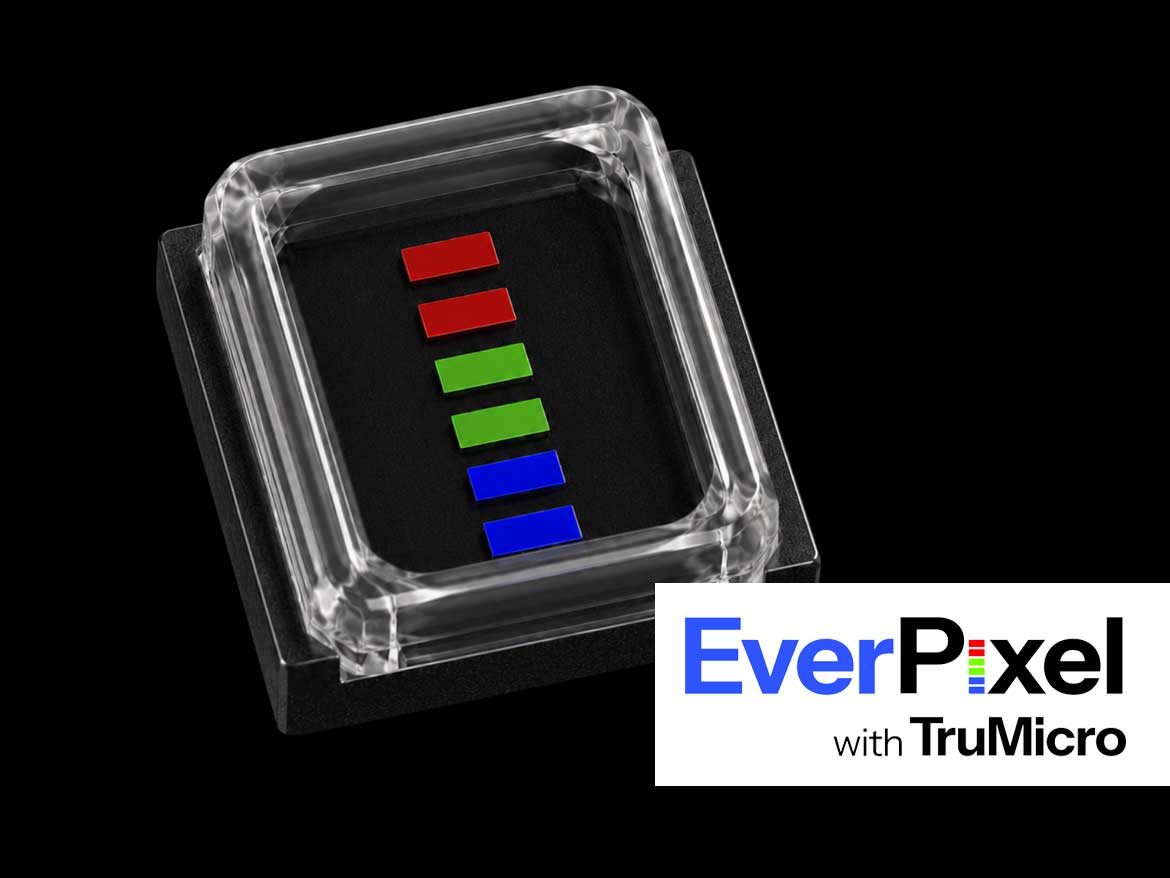
At InfoComm 2026, Planar’s Cobra Series LED Video Walls won a Best of Show Award from Sound & Video Contractor (SVC). This new modular direct view LED video wall system showcases Planar’s innovative TruMicro LED designs, allowing them to reduce the size of individual LED subpixels to microscopic size (20 microns for each red, green and blue subpixel) and enables the use of their EverPixel redundancy, which places two reds, two greens, and two blue subpixels in each pixel package – effectively eliminating the chance of full pixel outages.
Though it wasn’t a new release, for InfoComm 2026, Planar designed an entirely new demonstration of their dynamic, and lightweight LN Series—one of their modular LED video wall systems that can accommodate curved or waved, circular designs. Hanging from the ceiling above the Planar booth was an eye-catching spiral ribbon with LED video modules covering both the outside and inside of the structure. Quite an impression!
AI-assisted technologies continue to enhance user experience. Just a few examples:
Echo & Noise Cancellation
Numerous manufacturers build Smart Audio DSPs (digital signal processors) that use machine learning algorithms to perform real-time acoustic echo cancelling and gain control.
Beamforming Microphone Arrays
Intelligent ceiling microphone arrays run on neural network models that listen to spaces, locate the exact coordinates of human voices, and dynamically direct acoustic “beams” to track speakers, while blocking non-human noises.
Audio and Visual Fencing
Systems are able to create audio and video perimeters that dictate which voices and faces should included and what should be suppressed or cut out to keep focus on main participants.
Auto-Framing and Tracking Cameras
Systems utilize skeletal mapping and facial detection to track presenters fluidly as they move across a stage.
Auto Translation and Transcription
Many systems are able to translate and transcribe meeting dialogue.
System and Device Monitoring
Advanced maintenance platforms can track system power usage and signal strength to identify outages and even predict hardware failure before it happens.
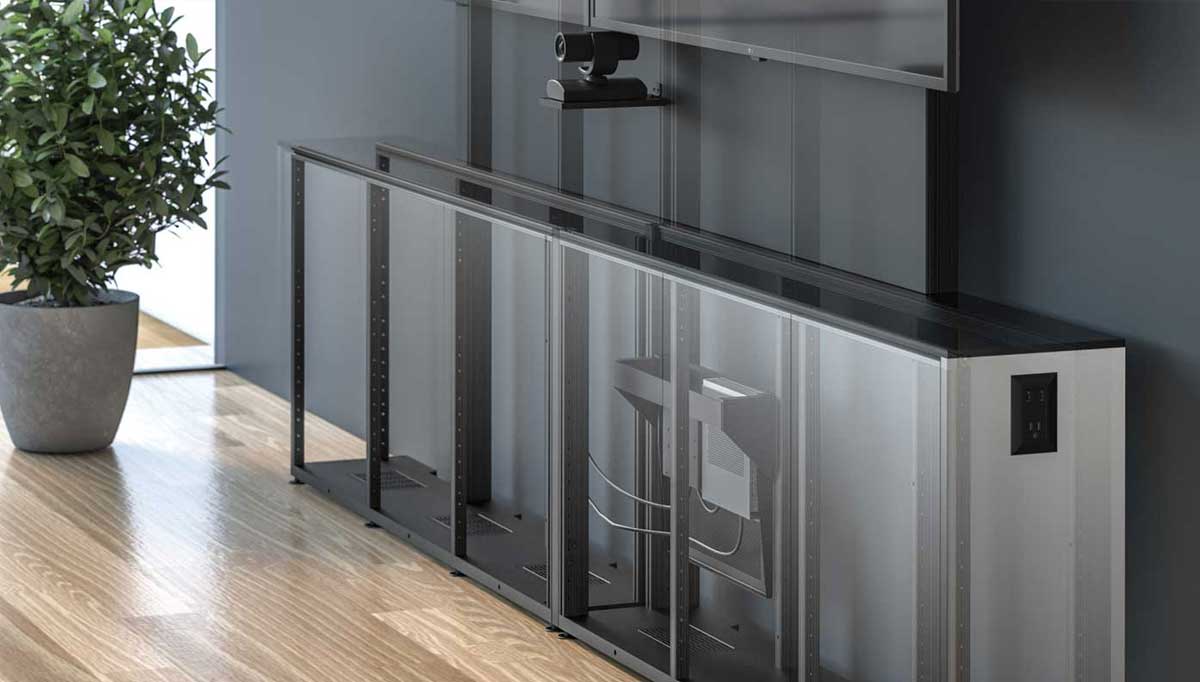
With the explosion of all-in-one video conferencing systems and large format video walls in the workplace, Salamander Design’s Display Stands and Cabinet Systems fill the niche for freestanding display systems that can support displays of nearly any size. Displays are mounted directly the stand, and system components and peripherals are all housed within the stand—eliminated the need for additional wall construction or structure reinforcement (and the additional trades needed for those projects.)
For small to medium sized spaces, the Salamander Designs Framed Media Wall can house 55″ – 86″ displays, sound bars, and cameras needed for conferencing or collaboration—all in an ADA compliant, free-standing, form. Front lift-off panels provide easy access to components within, and optional cooling systems can be integrated when needed. Connect the Media Wall to a conferencing table to create a huddle station.
When dual displays, 21:9 screens, or larger video walls are deployed, Salamander’s Pro Cabinets provide the solid internal structure and channeling needed to support larger systems and the wiring and equipment they require. Customizable — with options for integrated power, larger storage depths, ventilation and cooling, pull-out shelves and racks, and fridges — Pro Cabinets can be designed with a wide selection of finish and countertop options.
As BYOM devices continue to advance, connectivity methods to get your content on-screen seem to be ever-changing. USB-C is one of the latest connection methods being adopted in AV systems – and with good reason. With its ability to support hi-speed data transfer, “heavy power” needed for device charging, and 4K or even 8K video signals (plus the fact that its “reversible design” is never inserted the wrong way, unlike its predecessors 😉 ) USB-C has distinct advantages over older USB types and HDMI.
More and more, displays, projectors and AV switchers are including USB-C inputs – allowing a laptop or mobile device with USB-C to use just one cable to charge the device, hook up to share content, and connect to the internet or networks – all simultaneously, without additional dongles. Devices with USB-C connectivity can also directly control room peripherals like cameras, microphone arrays and soundbars, and can support advanced applications under the hood of AV systems.